Wednesday, September 2, 2009

Transcend dread: 8 ways to transform your care of ‘difficult’ patients


John
Battaglia, MD
Medical director, Program of assertive community treatment, Clinical associate professor, Department of psychiatry, University of Wisconsin, Madison, WI

Although “the difficult patient” is not a diagnosis or specific clinical entity, clinicians universally struggle with such patients and have an immediate sense of shared experience when describing the phenomenon. In primary care, O’Dowd aptly described this type of patient as the “heartsink” patient, meaning the practitioner often feels exasperation, defeat, or dislike when he or she sees the patient’s name on the schedule.

This article discusses the literature on this topic and provides strategies for dealing with difficult patients in psychiatric practice.

Read full text (free access)

Listen to Dr. Battaglia explain the advantages of "plussing" your difficult patient

Comment on this article

Email the editor

Help your bipolar disorder patients remain employed


Charles
L. Bowden, MD
Clinical professor of psychiatry and pharmacology, Nancy U. Karren Distinguished Chair of Psychiatry, The University of Texas Health Science Center at San Antonio

Bipolar disorder’s long-term course presents a therapeutic challenge when patients desire to remain employed, seek temporary or permanent disability status, or—most commonly—attempt to return to employment after a period of inability to work. As the experience of Mrs. S illustrates, previous capabilities that appear higher than the person’s present or recent work experience are a key issue to address in interpersonal therapy.

Evidence-based research is informative, but ultimately you must apply judgment and flexibility in setting and revising goals with the bipolar individual. Attention to the disorder’s core characteristics can help you equip patients for work that contributes to their pursuit of health.

Read full text (free access)

Comment on this article

Email the editor

Dissociative identity disorder: Time to remove it from DSM-V?


Numan
Gharaibeh, MD
Staff psychiatrist, Department of psychiatry, Danbury Hospital, Danbury, CT

Dr. Gharaibeh is a an attending psychiatrist on the inpatient unit at Danbury Hospital in Danbury, CT. He teaches psychiatric residents from New York Medical College during their rotation in Danbury Hospital and physician assistant students from Quinnipiac University, Hamden, CT.

What is it about dissociative identity disorder (DID) that makes it a polarizing diagnosis? Why does it split professionals into believers and nonbelievers, stirring up heated debates, high emotions, and fervor similar to what we see in religion?

The DID controversy is likely to continue beyond the fifth edition of the Diagnostic and Statistical Manual of Mental Disorders (DSM-V), slated for publication in 2012. Proponents and opponents claim to have the upper hand in arguments about the validity of the DID diagnosis and benefits vs harm of treatment. This article examines the logic of previous and new arguments.

Read full text (free access)

Comment on this article

Email the editor

Paradigms shift rapidly in antipsychotic treatment


Henry A. Nasrallah, MD
Editor-in-Chief

Like the “paradigm shift” Thomas Kuhn coined in his seminal book, The Structure of Scientific Revolutions, paradigm shifts have been occurring at a breathless pace in psychiatry. Thanks to ongoing research, changes in the clinical standard of care for schizophrenia in the past 20 years are a case in point.

Let’s take 1988 as a starting point. That’s when clozapine was “resurrected” as the only drug with proven efficacy in refractory schizophrenia after several first-generation antipsychotics (FGAs) had been tried. However, because of its potentially fatal side effect (agranulocytosis), clozapine was designated as an absolute last-resort agent. It also was stigmatized for its many other side effects, including serious metabolic complications.

Read full text (free access)

Comment on this article

Email the editor
Monday, August 3, 2009

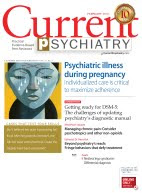
Life after near death: What interventions works for a suicide survivor?


Sarah M. Jacobs, MEd

Fourth-year medical student, Mayo Medical School, Rochester, MN

J. Michael Bostwick, MD
Associate professor of psychiatry, Mayo Clinic College of Medicine, Rochester, MN


Completed suicide provokes a multitude of questions: What motivated it? What interventions could have diverted it? Could anyone or anything have prevented it? The question of who dies by suicide often overshadows the question of what lessons suicide attempt (SA) survivors can teach us. Their story does not end with the attempt episode. For these patients, we have ongoing opportunities for interventions to make a difference.

A history of SA strongly predicts eventual completion, so we must try to identify which survivors will reattempt and complete suicide. This article addresses what is known about the psychiatry of suicide survivors—suicide motives and methods, clinical management, and short- and long-term outcomes—from the perspective that suicidality in this population may be a trait, with SA or deliberate self-harm (DSH) as its state-driven manifestations. When viewed in this manner, it is not just a question of who survives a suicide attempt, but who survives suicidality
.

Read full text (free access)

Listen to Dr. Bostwick explain how the 'script' of your patient's suicide attempt can help you plan effective treatment


Comment on this article

Email the editor

Is a medical illness causing your patient's depression?


Virginia K. Carroll, MD

Fifth-year resident, Departments of psychiatry and internal medicine, Rush University Medical Center, Chicago, IL

Jeffrey T. Rado, MD
Assistant Professor, Departments of psychiatry and internal medicine, Rush University Medical Center, Chicago, IL


A patient who comes to you for treatment of depression might also present with physical symptoms (such as, fatigue, nausea, balance problems, etc.) that could point to a medical illness. Endocrine, neurologic, infectious, and malignant processes and vitamin deficiencies could be causing your patient’s depression. To help differentiate various etiologies of depressive symptoms, we review common medical causes of depression, their distinguishing characteristics, and pertinent treatment issues.

DSM-IV-TR considers major depression secondary to a general medical condition to be diagnostically separate from a major depressive episode. When considering nonpsychiatric causes of depression, begin with a thorough medical history including current and past medications, illicit substance use, review of systems, and a detailed neurologic exam.

Read full text (free access)

Comment on this article

Email the editor

How to reduce distress and repetitive behaviors in patients with OCD


Elna Yadin, PhD

Research associate, Center for Treatment and Study of Anxiety, Department of psychiatry, University of Pennsylvania, Philadelphia, PA

Edna B. Foa, PhD
Professor and director, Center for Treatment and Study of Anxiety, Department of psychiatry, University of Pennsylvania, Philadelphia, PA


Exposure and response (or ritual) prevention has been shown to be effective in improving the therapeutic outlook for patients with obsessive-compulsive disorder (OCD). Yet barriers—including patient unwillingness to enter into the intensive therapy—prevent more persons with OCD from achieving an improved quality of life.

This article focuses on the clinical picture of OCD and the multifaceted cognitive-behavioral therapy (CBT) that has received the most empirical support. We also describe initiatives to make CBT more accessible to OCD patients, such as providing twice-weekly instead of daily treatment sessions.

Read full text (free access)

Comment on this article

Email the editor